
E-Sign vs Cryptographic Signatures

Most people place electronic signatures and cryptographic signatures in the same mental bucket. Both feel digital. Both feel official. Both let you sign from anywhere. Tools like DocuSign, Adobe Sign, Dropbox Sign, and Google Sign have made this experience routine, to the point where most teams never question what is happening behind the scenes.
But the two signature models are not just different. They belong to different worlds. One is built on trust in a platform. The other is built on proof you can verify yourself. Understanding this distinction is the starting point for understanding why we’re building Escra and why the industry must shift towards verifiable execution.
The e-Signature Model
Electronic signatures were designed for convenience. Their promise was simple. Replace printers and scanners with a click. Remove friction. Speed up workflows.
Every major e-sign tool follows the same pattern:
A user logs into an account.
The platform checks basic authentication.
The user clicks to sign.
The platform records that event in its internal audit log.
The signature is essentially the platform’s statement that the account clicked the button. All proof lives inside the vendor’s system. If a dispute ever arises, the vendor’s gate-keeps the evidence.
This used to be sufficient means for everyday agreements and internal approvals, but these structural limitations are now primary points of failure:
The platform trusts the account, not the person.
The audit trail is editable by the platform.
The signature cannot be independently validated.
A compromised account can still generate a valid signature.
The record is only as strong as the platform that issued it.
DocuSign, Adobe Sign, Dropbox Sign, Google Sign and others all rely on this same pattern. Strong branding, good design, convenience and broad adoption that do not address the underlying risks.
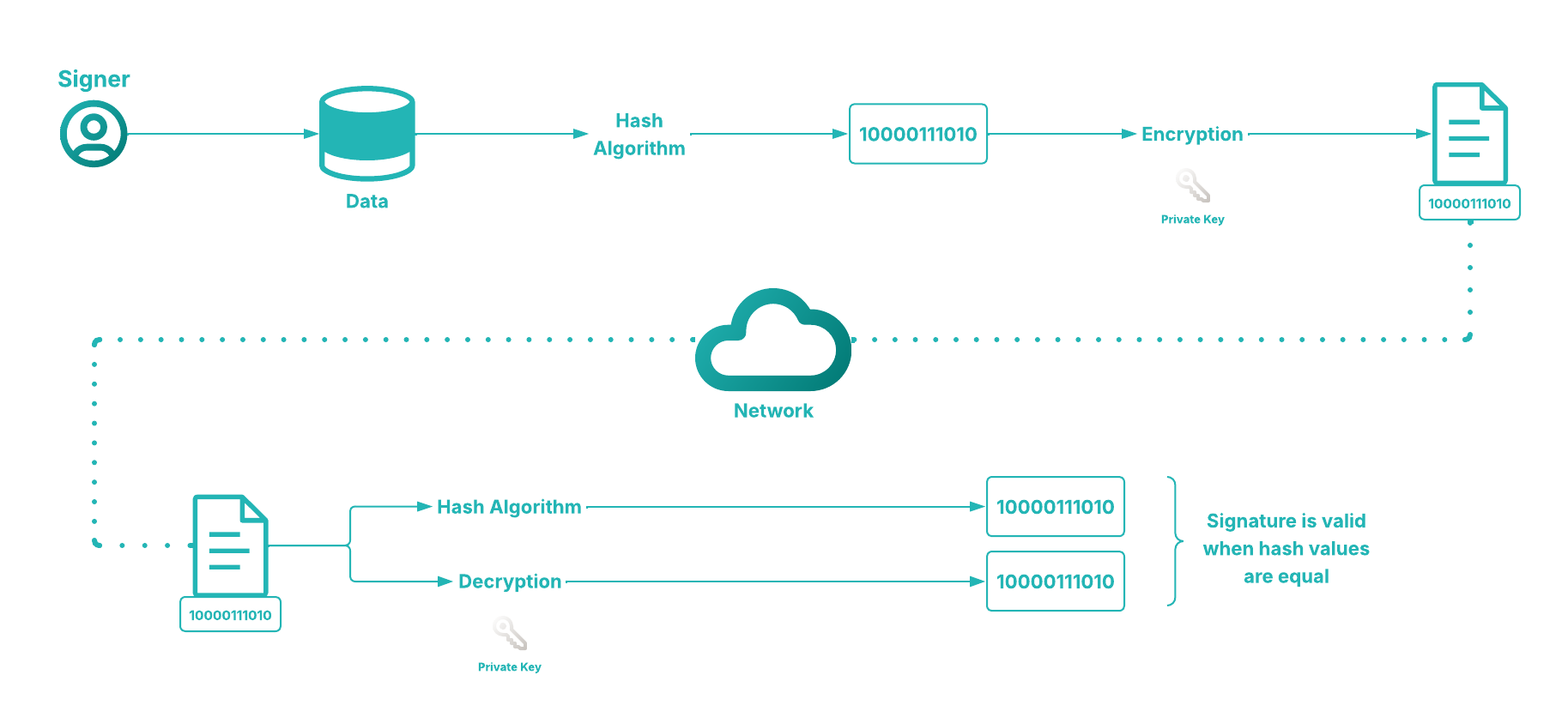
The Cryptographic Signature Model
Cryptographic signatures start with identity verification. A key pair is issued to a real person. That key becomes their digital identity for every action they take.
When they sign, they do not click a button that a platform vouches for. They use their private key, only they can access, to sign a smart contract that confirms their permission to participate. Anyone can verify their signature using their public key. No actions are taken without their explicit intent.
This creates a completely different security and trust profile:
Identity is proven, not assumed
The signature can be verified by anyone
The signature authenticity is validated by the contract itself
The audit trail exists independently of the platform
Compromise is far harder because keys are encrypted and cannot be falsified
The record becomes a mathematical truth rather than a vendor-generated statement
This is the foundation of verifiable execution. A world where contracts, documents and workflows are tied directly to people through verified identity and cryptographic proof.

Why this difference is becoming urgent…
Ten years ago, electronic signatures were enough. Fraud was lower. Regulatory scrutiny was lighter. Workflows were simpler. Businesses did not need high assurance around identity or execution. In short, we trusted each other and security was an afterthought.
Today the environment is different:
Identity fraud has exploded.
AI generated impersonation is growing faster than traditional tools can respond.
Organizations are expected to demonstrate not just compliance, but provability.
Critical workflows depend on signatures that carry the weight of the authority they represent.
Relying on account based signatures in this new environment preserves unnecessary risk. Teams need an agreement execution model that stands on its own, independent of the platform that facilitates it.
What this series will cover next
Over the next several posts, we will compare electronic signature providers one by one, to give teams a clear picture of what these systems do and do not provide.
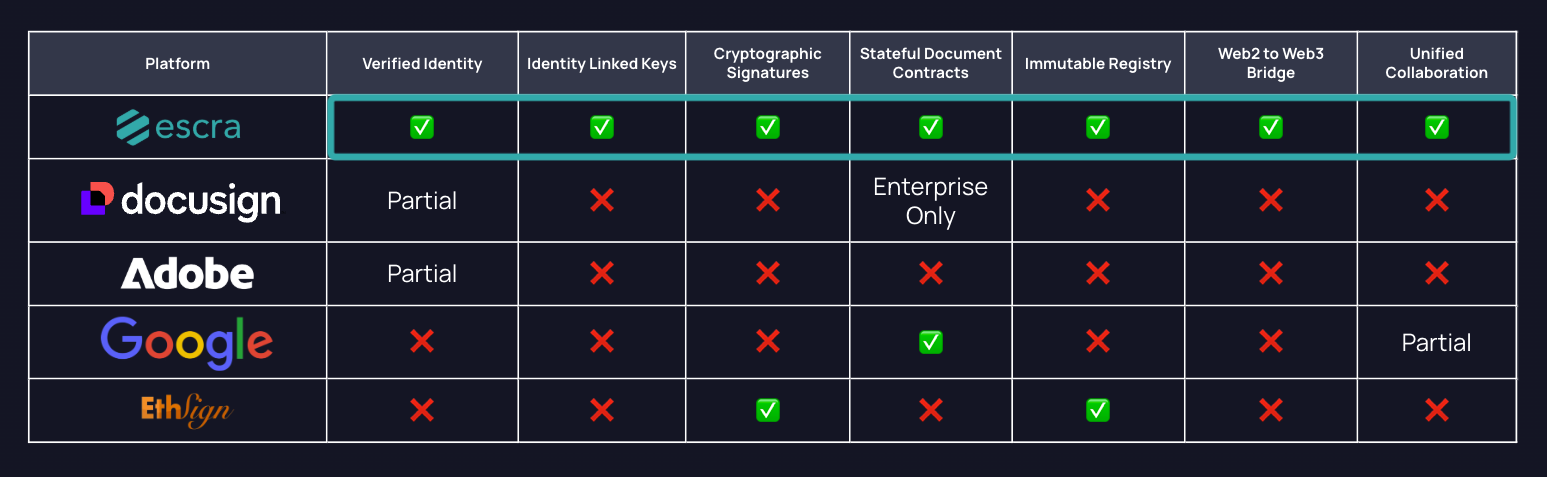
Information compiled from publicly available documentation and product demonstrations on the respective company websites of DocuSign, Adobe Sign, Google, EthSign and Escra.
Data accurate as of December 2025. Where specific features were not explicitly documented, assessments are based on available product information. Some features may require specific subscription tiers. Features and capabilities are subject to change.
Green Check (✓): Full feature set supported.
Yellow Dot (•): Partial or indirect support for the feature.
Red X (✗): Feature not available.
