
Under the Hood: Escra’s Signature Engine & On Chain Execution Workflow
In our first post, we introduced Escra and the idea of replacing trust-based e-signature tools with a trustless verifiable execution system. Now we can open the hood and show how Escra actually works inside, starting with identity, cryptographic keys, integrity chain, and the signing engine that ties everything together.
The Foundation: Chain-of-Identity
Every action in Escra is tied to a real person. The process begins with government-grade identity verification with an onboarding flow that checks personal or business information and verifies authenticity.
Each user then receives:
A verified proof of identity
A unique cryptographic key
Access to a unified contract lifecycle platform (CLM), and;
Peace of mind while transacting in an integrity-enforced ecosystem
This “chain-of-identity” is the backbone of the platform as every action is tied to a permanent audit trail on the blockchain.
But don’t worry if that sounds complicated. We’ve made it so easy and familiar you won’t even notice.
From PDF to Protocol: The Power of Smart Contracts
Escra uses a layered approach that mirrors how contracts work in the real world.
1. Parent Contract Projects
A parent smart contract is created when a new contract project begins.
It stores:
Collaborators
Identity linked keys
Contract level permissions
Essential contract data
Contract status changes
Rules for how the contract must progress
Essential identifiers for any associated documents
The project acts as the shared execution environment for everything inside it.
2. Document Children
Each document also becomes intelligent, recording:
Essential document data
Document level permissions
Document status changes
Expected signers and their keys
Logic for verifying signature authenticity
Each document moves through its own state changes and is inextricably linked with its parent contract project.
The New Standard for Signing
A digital pen only you can use.
When you sign a document, you are not simply clicking a simulated signature field. You are submitting a cryptographic transaction backed by your verified identity. That transaction is recorded permanently on the blockchain. No fake signatures, no ambiguity, just tamper-proof evidence that you, and only you, authorized your agreement.
Our signature engine checks:
Is the signer verified?
Is this the key assigned to that identity?
Is this key listed as an expected signer?
Has this signature been used already?
Is the document in a state that allows signatures?
Have all the required signers executed the document?
If all checks pass, your smart document is completed and recorded forever.
No versioning risk, no duplicates, no assumptions, just proof and a single source of truth.
State Transitions & Finalization
As each collaborator completes their part, your contracts and documents update their states. When all documents reach completion, the parent contract projects records the final registry event. This registry entry is the permanent, immutable record of the completed transaction.
The entire process is cryptographically bound, identity anchored, and objective.
The Unified Collaboration Stack
Contracts do not live in isolation. They involve communication, coordination, and shifting workloads. For this reason, Escra has a built-in project management interface that keeps all your tasks in one place so teams do not need to bounce between multiple tools.
The collaboration layer provides:
Kanban style boards and tables
Task management for assignments, reviews, and internal action items
In app messaging tied directly to documents, tasks and contract projects
Notifications and reminders
An activity timeline tracking all on-chain and off-chain events
This keeps the execution flow clean and gives every participant a single tool for communication, tracking, and execution.
Who does this matter?
This approach gives users a system where:
Every signer is verified
Every signature is cryptographic
Every contract and document is stateful
Every step is recorded on chain
Every final contract has an immutable registry entry, and;
All parties can work together in one place
It removes ambiguity and replaces it with verifiable truth.
What’s Next?
To help you understand how Escra compares to existing tools, here is a simple snapshot of how Escra stacks up against the competition today.
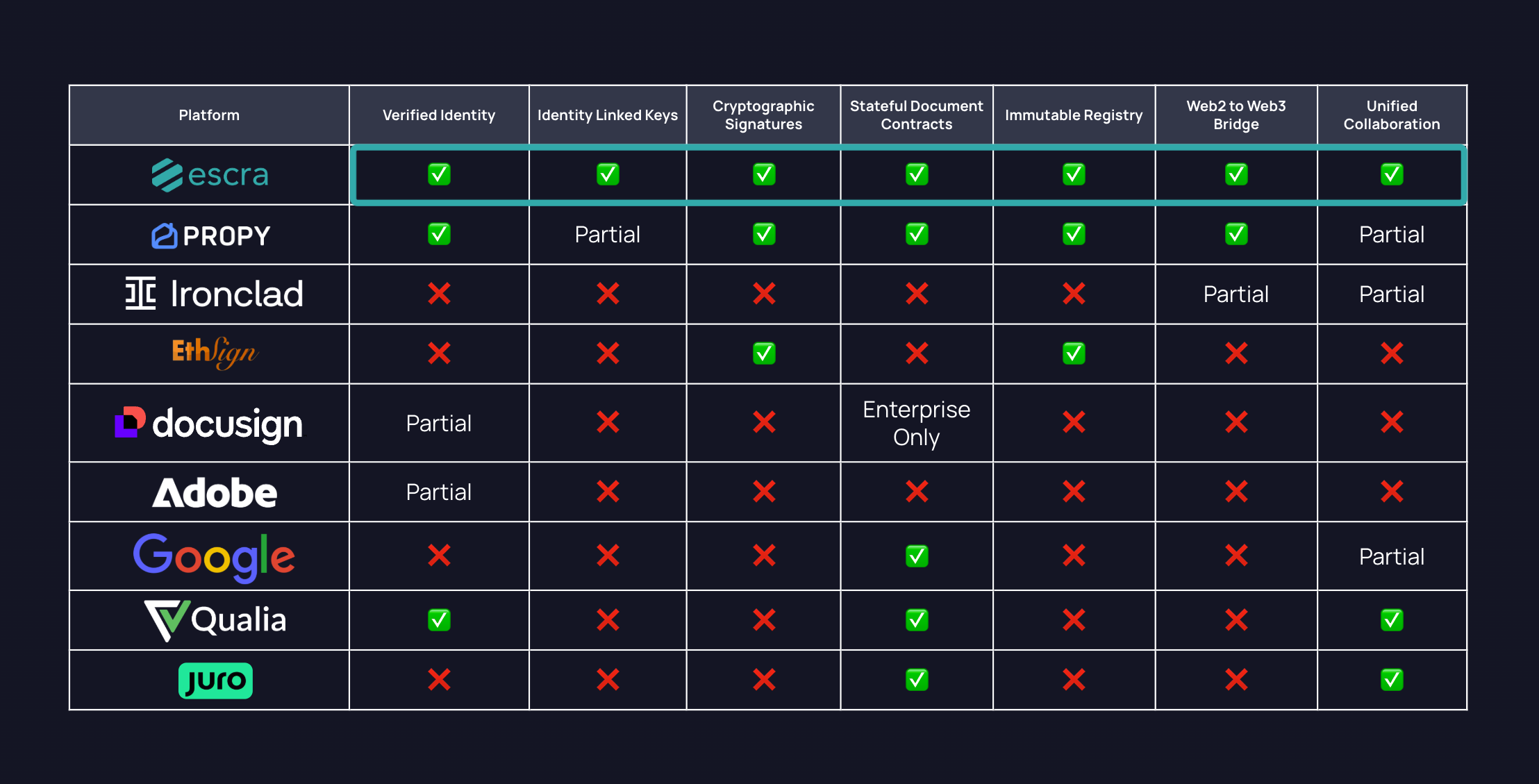
Information compiled from publicly available documentation and product demonstrations on the respective company websites of DocuSign, Adobe Sign, Google, Propy, Qualia, Juro, Ironclad, EthSign and Escra.
Data accurate as of November 2025. Where specific features were not explicitly documented, assessments are based on available product information. Some features may require specific subscription tiers. Features and capabilities are subject to change.
Green Check (✓): Full feature set supported.
Yellow Dot (•): Partial or indirect support for the feature.
Red X (✗): Feature not available.
This quick view only scratches the surface. Each of these tools takes a different approach to signatures, workflows, and record keeping. In our next posts, we will break down each competitor individually and show how their systems work under the hood, then show how Escra approaches the same problems.
Next up in the series: DocuSign and the gap between electronic signatures and cryptographic signatures.
