
Adobe Sign vs Escra: Identity, Proof & Auditability
Adobe Sign is a well known electronic signature platform embedded within Adobe’s productivity ecosystem. It offers strong usability, template management, and workflow routing for teams that need fast document execution. Escra approaches the same category from a different foundation. Instead of relying on account based clicks, Escra ties signatures to verified identity and cryptographic proof.
This comparison outlines where Adobe Sign works well and where Escra provides higher assurance.
How does Adobe Sign’s model work?
Adobe Sign is built for convenience and scale across common business workflows.
Users authenticate into an account
They click to sign
Adobe records the event in its platform audit trail
Documents move through role based routing
This makes Adobe Sign effective for sales teams, HR flows, procurement, and general business approvals.
The limits of the traditional model:
Identity
In many traditional e-signature systems, the signing event is tied to an authenticated account or session rather than to a cryptographically bound individual identity. Identity verification often happens before or outside the signing moment and relies on standard authentication methods such as email access, passwords, or MFA. If those credentials are compromised, the system may still register the action as valid because the platform confirms the account activity, not the person behind it.
Proof
Traditional e-signature platforms generally record evidence of a signing event through platform generated logs and audit records. These records indicate that an action occurred within the system but do not typically create a standalone cryptographic artifact that can be independently verified outside the platform.
Auditability
Audit trails in conventional e-signature systems are usually platform controlled. While logs can be exported and reviewed, their validity depends on trust in the platform that generated them. They describe what the system observed, rather than providing mathematically verifiable proof that can be validated independently. These constraints reflect the original design goals of most e-signature tools, which prioritize usability, speed, and workflow efficiency.
Execution Assurance
Adobe Sign manages workflow steps but does not enforce execution through cryptographic signing or on-chain immutable mechanisms.
How Escra differs:
Escra begins with verified identity. Each user receives a key pair tied directly to their identity. Every signature is produced with that key and can be verified by anyone without relying on Escra’s systems.
This creates a different security profile.
The signature itself is the proof
Records are immutable
Verification does not require trust in Escra
Identity is confirmed, not assumed
High value workflows can rely on evidence rather than platform logs
Escra can also support lower assurance account based signing, but it is not the core model.
When might Adobe Sign is a good fit?
Sales operations
HR workflows
Vendor onboarding
Low risk agreements
Organizations already committed to Adobe ecosystems
Adobe Sign excels when workflows are routine and identity assurance is not critical.
When does Escra becomes the preferred option?
Financial or regulated agreements
High assurance workflows
Multi party transactions
Environments with identity or fraud risk
Organizations that need independently verifiable signatures
Escra provides a verifiable execution layer where trust cannot rest solely on a platform.
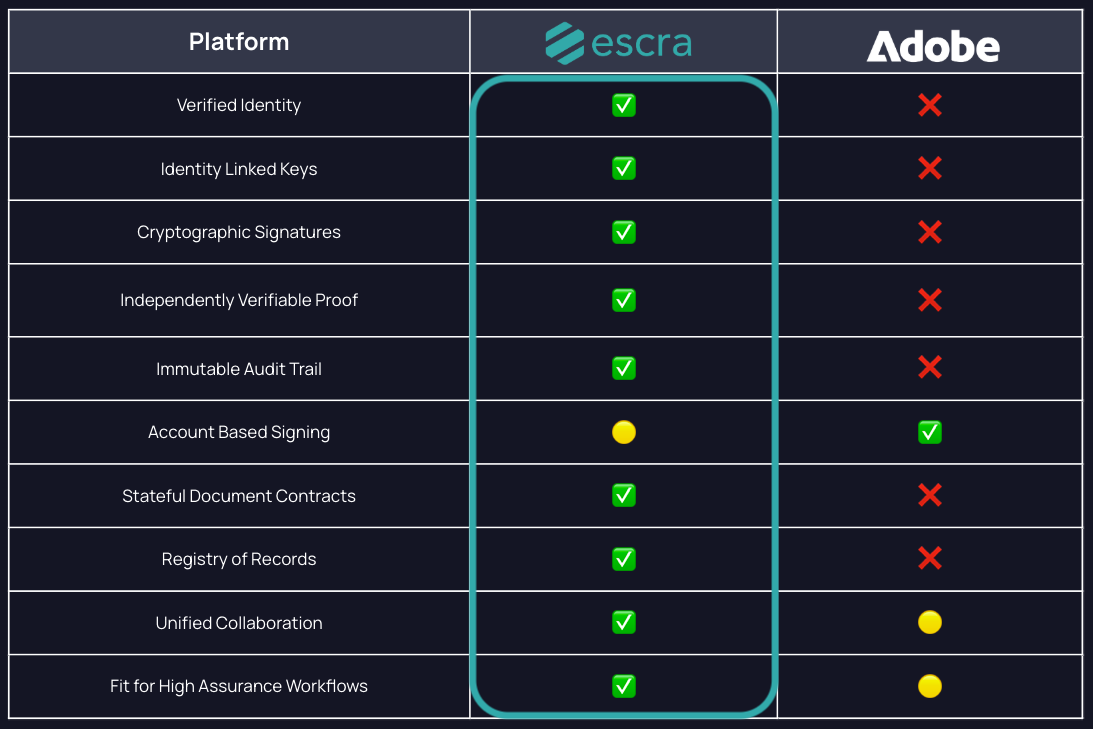
Information compiled from publicly available documentation and product demonstrations on the respective company website of Adobe.
Data accurate as of December 2025. Where specific features were not explicitly documented, assessments are based on available product information. Some features may require specific subscription tiers. Features and capabilities are subject to change.
